
Brandon Jennings, an 18 year old graduate out of Oak Hill Academy, has decided to skip attending college at the University of Arizona and instead sign with Pallacanestro Virtus Roma of the Italian pro league. The number one rated point guard recruit in the country could not enter this year's draft because of league rules stating players must be 19 years old (Jennings turns 19 on September 23) and at least one year removed from high school. Presented with the opportunity to play at such a powerhouse as Arizona (who has provided such pros as Gilbert Arenas, Andre Iguodala, Jason Terry and Mike Bibby), Jennings was waiting for scores from standardized tests before he could officially be accepted to the university.

I am not opposed to individual doing whatever they can to earn a living for themselves and supporting their family. I am opposed to seeking and taking the easy/more lucrative way out when other, better, opportunities are available. There is no reason for Jennings to do this other than the money. He will not be as big in the public eye as he would have been playing for a popular university like Arizona. He will not be receiving the same level of coaching that he could have gotten from Lute Olson, a legend in his own right. (Sidebar: Olson has claimed never to recruit "one-and-dones" again based on Jennings' actions.) Kids are so quick to start their professional careers, they are going to regret skipping the college experience. Ask Matt Leinart why he stayed at USC for another year when he could've been the number one pick in the 2005 NFL Draft (to be drafted 10th the next year), and he will say it was because he couldn't leave the college experience. It was too much fun. Not to mention the actual education Jennings would be receiving and have the opportunity to go back and finish at some point. A free college education is something thousands of high school graduates every year wish they had, and these ball players take it completely for granted.
One-and-done players (Michael Beasley (below, left), Eric Gordon (below, right)) have a devastating effect on the teams they join.
 Much time, effort and money is spent going after these superstar athletes who have no intention of sticking around and helping the university. College basketball suffers by not having its athletes remain with the team and create a sense of continuity with fans.The only positive to this is that there is a lot more parity in the game than there used to be. Small schools (i.e. George Mason in '06, Davidson this year) have been able to play with some of the best schools in the country because their players are willing to stay in school and create the chemistry that is required to be a great team. Schools with this mentality have a good chance of keeping up with other schools who rely solely on their one star to carry them in every game.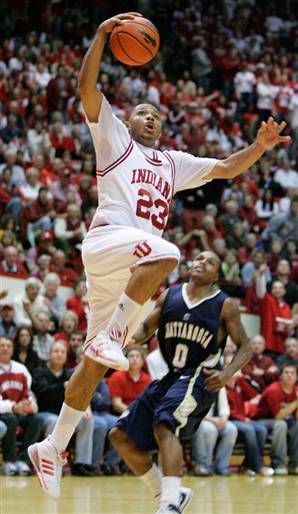
With this first step that the NBA and the Player's Union have taken, hopefully they can continue down this same path. The present collective bargaining agreement ends after the 2010-2011 season. In negotiating the new CBA, commissioner David Stern and the NBA will attempt to institute a 2-year rule in which players must be two years removed from high school instead of the current 1 year requirement. This can only help all sides involved (except for players looking to get paid as quickly as possible, but who wants them, anyway?). Schools keep their stars for two years, helping chemistry and revenue. Players get two years of education, usually enough time for someone to get interested in a subject and want to pursue a degree in it. And the NBA gets players who are more mature, better able to handle the world of the NBA both on the court and off it.
Don't get me wrong. I wish Brandon Jennings all the luck in the world, and I hope this works out well for him. In fact, I hope it works out so well, he never comes back! Good luck, Brandon, we're all rooting for ya! (In one way or another.)

2 comments:
You ignore the fact that Brandon Jennings is from a low income family that could really use the $600,000 he'll be making overseas. I agree with you that the one year rule is absolute bullshit, but instead of two years would like to see no college requirement. I agree that schools spend way too much revenue on one and done players that sometimes even hurt teams more than they help them... the solution, let these kids go straight to the pros. There should be no restriction on when kids should be able to make money. Some basketball players with the ability to play in the NBA have no interest in college, the college lifestyle, even academics. Does this make them evil money grubbing villains as you make them seem? No. They just want to play basketball, and as a legal adult at eighteen why shouldn't you let them if they have the ability to play in the NBA? Trying to save college basketball ratings by making players wait a year or two for a multimillion dollar contract is selfish to you as a college basketball fan. Try to empathize a bit more with these players... you're a top 5 prospect from a low income family with no interest in college, you just love to play basketball. On one side, guaranteed $600,000 contract, on the other, something you are unsure that you even want to do let alone know if you can handle the academic workload. These people aren't evil money grubbing assholes, most of the time they're just people looking out for what's best for their family. At the same time with no college requirement, players that want to go to college, to experience the "college lifestyle" have the opportunity to. As a college basketball fan you're still able to see highly competitive games, and a lot of great "late bloomers." The NBA has no right to tell their players how have to be past 18 to enter their league, or how many years of college/semi-pro ball you have to play. The only other sport that does this is football and that's done for twofold reasons. One, most football players out of high school aren't physically/athletically/mentally ready to play, football is a different game than basketball. Two, college football makes a shitton of money, a lot more than college basketball.
*parity, not "parody"
Post a Comment