After watching some college basketball this week (the most I've watched all season), I deemed myself informed enough to construct what would be my Dream Team from this college season. Along the way, might as well compare them to a current NBA player, right? Let's go.
PG - Jordan McLaughlin (USC) 6'1", 175 lbgs
12.4 ppg, 7.4 apg, 2 spg, 21.2 PER, 4.9 WS
Pro Comparison - Jeff Teague (Minnesota) 6'2", 185 lbs
13.7 ppg, 6.9 assists, 1.5 spg, 15.8 PER, 3.5 WS
McLaughlin controls possession of the ball long enough to be considered the offensive initiator, but doesn't dominate it so much that the offense has to run through him. So he's no Chris Paul, James Harden or Russell Westbrook and doesn't have that kind of scoring ability, but he's shifty enough to get a shot off as needed, attack the basket, and move the ball around. He brings energy without requiring all the attention. Teague has been doing all of those things his entire NBA career.
SG - Grayson Allen (Duke) 6'4", 195 lbs
14.7 ppg, 3.5 rpg, 4.5 apg, 2.7 3pg, 19.1 PER, 5.3 WS
Pro Comparison - C.J. McCollum (Portland) 6'3", 190 lbs
21.8 ppg, 4.0 rpg, 3.2 apg, 2.5 3pg, 17.4 PER, 5.7 WS
Your first question is probably something like: Is Allen the pure scorer that McCollum is? Yes. He averaged 21 ppg as a sophomore when he was the number one option on Duke, with Brandon Ingram as Option Two. Duke has been laden with stud freshmen the last two years (Jayson Tatum, Frank Jackson, Harry Giles last year; Marvin Bagley, Wendell Carter, Gary Trent this year), so he hasn't had to carry the offensive scoring load. But he's been the best pure shooter on the team over the last three years, he's athletic enough to create his own shot when needed, and he performs best in clutch time. He comes with some baggage and controversy, but it that's easy enough to overcome.
SF - Theo Pinson (UNC) 6'6", 195 lbs
10.5 ppg, 6.3 rpg, 4.8 apg, 19.3 PER, 3.9 WS
Pro Comparison - Will Barton (Denver) 6'6", 175 lbs
15 ppg, 5 rpg, 4.2 apg, 16.1 PER, 4.9 WS
Besides Ayton, Pinson is the single-most impressive player I've watched recently. He resembles a younger Andre Iguodala: able to defend multiple positions; fully capable of bringing the ball down the court and initiating the offense or spacing the floor and letting everyone else do their thing; capable rebounder; above-average passer. That's an underrated assessment of his passing. During UNC/Duke in the ACC Tournament semifinal the other night, Pinson was on the ground during a rebound sequence, the ball ended up in his lap, and from his seated position he passed the ball to a teammate for a layup. It was quick and instinctual, and Jay Bilas could not contain his enthusiasm about the play. Except, he made TWO passes that were significantly better in a 90-second span later in the game. One on a drive to the basket, he went no-look, behind his head, through the raised arms of a chasing defender, and hit his teammate right in the hands. The next one was a laser from the top of the key to the baseline through Duke's zone for a wide-open jump shot. And those were just a small sample size. His court awareness, vision, and execution made him the best all-around player on the floor that night.
PF - Ethan Happ (Wisconsin) 6'10", 235 lbs
17.9 ppg, 8 rpg, 52.8 fg%, 29.3 PER, 4.6 WS
Pro Comparison - Nikola Jokic (Denver) 6'10", 250 lbs
17.1 ppg, 10.4 rpg, 49.1 fg%, 23.7 PER, 7.7 WS
I've been a fan of Happ's since the 2016 NCAA tournament. As a freshman on a team featuring juniors Nigel Hayes and Bronson Koenig, Happ finished third in scoring, and first in rebounding, field goal percentage, player efficiency rating, and win shares. During their three games in the tournament, he had the most total points and rebounds for Wisconsin. He's a constant contributor, who is shifty and confident around the basket and makes the right play more often than not. He's also averaged 1 block and 1.5 steals per game over his career, so he's an active presence on defense. Jokic might be a little flashier, but for big guys they both control the ball well and keep their teammates involved.
C - DeAndre Ayton (Arizona) 7'1", 250 lbs
19.9 ppg, 11.3 rpg, 61.3 fg%, 32.5 PER, 7.2 WS
Pro Comparison - Joel Embiid (Philadelphia) 7'0", 250 lbs
23.4 ppg, 11.0 rpg, 48.5 fg%, 22.8 PER, 5.1 WS
DeAndre Ayton is a grown man playing among children. How he's not averaging between 25 and 30 points per game is beyond me. He plays above the rim more ferociously than anyone in the country, he has great footwork and low post moves over both shoulders, and he has a reliable jump shot out to 20 feet. The comparison to Embiid doesn't do justice for Ayton because he is significantly more agile. Think late-2000s Amar'e Stoudemire, running by everybody his size and powering through/flying over anyone smaller.
Concluding Notes:
-I would have picked Joel Berry over McLaughlin but I didn't want to have two guys from the same school.
-This team works for me because there are three guys who can/will/don't have to bring the ball up. They are willing and able for their teams, and often do, but they don't need the ball in their hands all the time in order to make things happen.
-Two incredibly skilled big guys, including one who can easily space the court.
-Pinson as a perimeter defender who can guard almost anybody (Pinson had to guard Marvin Bagley the other night), and Ayton as an intimidating rim protector.
-Tenacity and experience all over the place. Ayton is the only one younger than a junior.
-Not that Jalen Brunson and Luke May and Mohamed Bamba and Collin Sexton and all the Duke freshmen and any other top college players aren't also terrific (they are), but these five guys make up a team I would be proud to have. I expect at least three of them to make the Elite 8.
Sunday, March 11, 2018

Friday, July 7, 2017
Reflections on Lakers Summer League Opener
Some of my takeaways from watching the Lakers' Las Vegas Summer League opener against the Clippers.
1. Brandon Ingram was by far the best player on the floor, and he was playing like he knows he is the best player on the Lakers. This version of him is who I was excited about being drafted last year. Now, with D'Angelo Russell out of the way, Ingram gets to be the floor general and play with a more aggressive style. He was successful every time he put the ball on the floor and attacked the basket, and his jump shot looked confident and reliable.
2. I really want Ivica Zubac to develop into a serviceable big man, but it looks like he still has a long way to go. It is evident that he has some skills, but he still hesitates and doesn't carry himself with any sense of strength or aggression.
3. Vander Blue could be Lou Williams. A pure energy scorer off the bench, able to attack the basket at will and can seemingly create his own shot whenever he wants.
4. Lonzo Ball plays the game so fast, he's ahead of everyone but Ingram. His shooting totals (2 for 15, 1 for 11 from 3) were pretty disappointing, but at least three of those shots were end-of-clock heaves. It wasn't until his seventh attempt that he made his first three. I understand continuing to put shots up because he wanted to see one go in. I'm actually glad he did. But continuing to put up the same shots after that seemed unnecessary. I wanted to see him default to attacking the basket more and get his teammates accustomed to what that's going to look like and when to expect passes to be flying at them.
5. Lavar Ball's halftime interview is the best sound clip I have ever heard out of him. He put the attention on Lonzo, acknowledged a changing Laker culture and that the team winning is ahead of Lonzo's performance, and declared that Lonzo's relationship with Magic is the most important thing for Lonzo moving forward. If this is the version of Lavar that becomes the norm, I will be very pleased.
6. I really like Sindarius Thornwell of the Clippers. His performance and leadership during the NCAA tournament last year, single-handedly propelling the Gamecocks to their first Final Four appearance, was incredible. There are some doubts regarding his size and athleticism translating into the NBA, but he repeatedly made intelligent basketball plays today, and his physical abilities look like they are more than enough to get the job done.
1. Brandon Ingram was by far the best player on the floor, and he was playing like he knows he is the best player on the Lakers. This version of him is who I was excited about being drafted last year. Now, with D'Angelo Russell out of the way, Ingram gets to be the floor general and play with a more aggressive style. He was successful every time he put the ball on the floor and attacked the basket, and his jump shot looked confident and reliable.
2. I really want Ivica Zubac to develop into a serviceable big man, but it looks like he still has a long way to go. It is evident that he has some skills, but he still hesitates and doesn't carry himself with any sense of strength or aggression.
3. Vander Blue could be Lou Williams. A pure energy scorer off the bench, able to attack the basket at will and can seemingly create his own shot whenever he wants.
4. Lonzo Ball plays the game so fast, he's ahead of everyone but Ingram. His shooting totals (2 for 15, 1 for 11 from 3) were pretty disappointing, but at least three of those shots were end-of-clock heaves. It wasn't until his seventh attempt that he made his first three. I understand continuing to put shots up because he wanted to see one go in. I'm actually glad he did. But continuing to put up the same shots after that seemed unnecessary. I wanted to see him default to attacking the basket more and get his teammates accustomed to what that's going to look like and when to expect passes to be flying at them.
5. Lavar Ball's halftime interview is the best sound clip I have ever heard out of him. He put the attention on Lonzo, acknowledged a changing Laker culture and that the team winning is ahead of Lonzo's performance, and declared that Lonzo's relationship with Magic is the most important thing for Lonzo moving forward. If this is the version of Lavar that becomes the norm, I will be very pleased.
6. I really like Sindarius Thornwell of the Clippers. His performance and leadership during the NCAA tournament last year, single-handedly propelling the Gamecocks to their first Final Four appearance, was incredible. There are some doubts regarding his size and athleticism translating into the NBA, but he repeatedly made intelligent basketball plays today, and his physical abilities look like they are more than enough to get the job done.
Saturday, August 20, 2016
The Kid: A Tribue
One of the lasting tracks from my childhood that will play in my mind for the rest of my life is attached to the following introduction:
"Hi. This is Ken Griffey Jr. Let's play major league baseball."
Ken Griffey Jr. was officially inducted in the Major League Baseball Hall of Fame on Sunday, July 24, six years after his last game with the Seattle Mariners. His was a career that started as a teenager with the expectations of a number-one overall pick, featured games played in four different decades, and became one of the most productive and exciting careers in the sport's long and storied history.
He made his debut on April 3, 1989. During his first at bat, the announcer made the following proclamation: "20, 25 years from now, you're going to want to say 'I was there when Ken Griffey Jr. made his home debut.' " On the second pitch he ever saw, Griffey lined a Dave Stewart fastball off of the bottom of the left-center wall for a double. Many players throughout history have done more with their first pitch, so I am not proclaiming this event as clear evidence of what he was to become. But it does add to the legend that is George Kenneth Griffey II.
It is difficult for me to compare athletes across sports, distinguishing between basketball and football and baseball and hockey and golf and tennis players as to who a single-favorite athlete to personally behold and witness wondrously would be. Michael Jordan and Kobe Bryant have their place at the table. LaDainian Tomlinson, Marshall Faulk and Calvin Johnson join the conversation. Alexander Ovechkin, Tiger Woods, and Roger Federer have all provided the highest forms of entertainment I have ever witnessed. But there is no athlete I have ever seen play in my lifetime (or ever, for that matter) who I loved watching play their sport more than Ken Griffey Jr. And there are three main reasons.
1. The Swing.
I can watch it over, and over, and over again. It is touted repeatedly as the sweetest swing that has ever graced the diamond. There's even a Reddit article from two years ago professing his superiority. And another one from six months ago, giving a little more fan analysis and swooning. Fans aren't the only ones who drool over it. Sean Casey was Griffey's teammate in Cincinnati for several years, and gives his own breakdown of why Junior's swing was so sweet. It begins with the early load, like a gun cocked and ready for action: back elbow high, hands behind his body, so there's no wasted movement in preparing as the pitch comes. The swing starts as his front foot steps forward eight to ten inches, further engaging the coil waiting to unleash on the unsuspecting ball. Then, like a whip, the whole motion is unfurled in a blaze of power and precision. Arms drive forward, compact and firm. The spine and back leg align to form a sturdy base that, when coupled with the strength generated by his driving core, expels force in waves. Once contact is made and the baseball begins its journey to the waiting hands of spectators many rows beyond the wall, Griffey's follow through is another sight to behold. The arms peak above his head as his left hand releases the handle and the right hand is left to continue on its own. He majestically completes the full arc of the swing to below his hip. The conclusion is a statuesque pose worthy of a Renaissance sculptor:

There is no athletic sequence I take more joy from watching repeatedly than Ken Griffey Jr. hitting home runs. I have spent hours upon hours enamored by the perfect combination of smooth, graceful power he showcased for 20 years in a simple, exquisite action.
For good measure, I'll just leave this video here:
For a quick photo summary of Ken Griffey Jr. personality snapshots, look at these baseball cards. He smiles. He smiles a lot. He smiles All. The. Time. Even at the bottom of dogpiles, which is never comfortable or enjoyable, he smiles. He enjoyed playing baseball every second he was out there, and he made sure you knew it all the while.
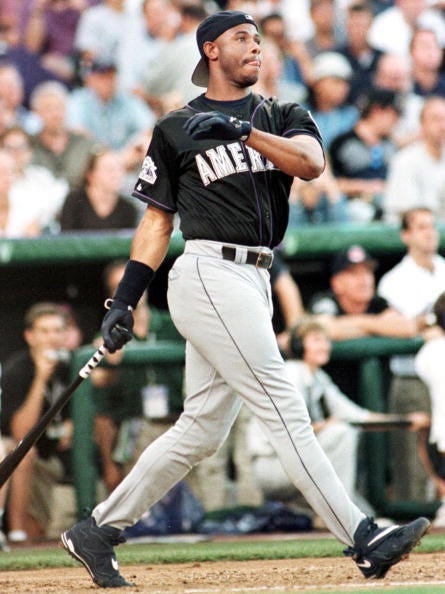 Then there's the backwards hat. Few images evoke joy and youth more than seeing somebody with their baseball cap backwards on their heads. Nobody wore it better than Ken Griffey Jr. During batting practice, for photo shoots, and at home run derbys, he made that style look cool and required for all athletic endeavors. To this day, I wear my hat backwards during at-bats in adult softball league situations and when I'm on the field playing ultimate frisbee. The backwards hat is such an indelible part of his legacy, he broke it out at the end of his Hall of Fame induction speech, while analysts and fans of all ages from all parts of the country clamored for it to be on his Hall of Fame plaque. Who else would engender such a cult following for such a trivial piece of material than a player like Griffey?
1. The Swing.
I can watch it over, and over, and over again. It is touted repeatedly as the sweetest swing that has ever graced the diamond. There's even a Reddit article from two years ago professing his superiority. And another one from six months ago, giving a little more fan analysis and swooning. Fans aren't the only ones who drool over it. Sean Casey was Griffey's teammate in Cincinnati for several years, and gives his own breakdown of why Junior's swing was so sweet. It begins with the early load, like a gun cocked and ready for action: back elbow high, hands behind his body, so there's no wasted movement in preparing as the pitch comes. The swing starts as his front foot steps forward eight to ten inches, further engaging the coil waiting to unleash on the unsuspecting ball. Then, like a whip, the whole motion is unfurled in a blaze of power and precision. Arms drive forward, compact and firm. The spine and back leg align to form a sturdy base that, when coupled with the strength generated by his driving core, expels force in waves. Once contact is made and the baseball begins its journey to the waiting hands of spectators many rows beyond the wall, Griffey's follow through is another sight to behold. The arms peak above his head as his left hand releases the handle and the right hand is left to continue on its own. He majestically completes the full arc of the swing to below his hip. The conclusion is a statuesque pose worthy of a Renaissance sculptor:

There is no athletic sequence I take more joy from watching repeatedly than Ken Griffey Jr. hitting home runs. I have spent hours upon hours enamored by the perfect combination of smooth, graceful power he showcased for 20 years in a simple, exquisite action.
For good measure, I'll just leave this video here:
2. The Glove
Let's get this out of the way early: Willie Mays is not only the greatest baseball player who ever lived (not up for debate), but is by far the best defensive presence to ever roam the outfield (even less debatable). As centerfielders go, Ken Griffey Jr. is right behind him with a small handful of others.
I am a firm believer in the cliche "Defense wins championships." I love a well-executed backcheck in hockey. If I had pursued playing football in high school, defensive end would have been my position of choice, in the hopes of becoming J.J. Watt. There are few basketball players I enjoyed watching, or having on my fantasy team, more than Ben Wallace; his highlight video consists of just as many blocks as it does dunks.
Ken Griffey Jr. brought just as much excitement to the centerfield position. If only Marv Albert had been a baseball commentator so he could proclaim his well-known phrase "With no regard for human life!" in reference specifically to Griffey launching his body into walls and onto the turf in repeated efforts to record outs. He won ten straight Gold Gloves (1990-99), one of just six outfielders ever to win such a total and one of five to win so many consecutively. Sabermetricians will tell you that Griffey was nobody to raise a candle to, but the eye test and praise of his peers is good enough for me. Certain defensive images will remain with me forever (Jim Edmonds diving with his back to the infield, Gary Matthews Jr scaling and twisting high above a wall, Derek Jeter flying into the stands, etc.), and Griffey has multiple spots: robbing Luis Gonzalez of a home run, crashing two-footed into the wall against Ruben Sierra, and youthfully soaring above the wall to take a four-bagger away from Jesse Barfield. Those three plays in particular display, in order, his supreme athleticism, reckless abandon, and the third Griffey quality that completes his legend...
3. The Personality
For a quick photo summary of Ken Griffey Jr. personality snapshots, look at these baseball cards. He smiles. He smiles a lot. He smiles All. The. Time. Even at the bottom of dogpiles, which is never comfortable or enjoyable, he smiles. He enjoyed playing baseball every second he was out there, and he made sure you knew it all the while.
Then there's the backwards hat. Few images evoke joy and youth more than seeing somebody with their baseball cap backwards on their heads. Nobody wore it better than Ken Griffey Jr. During batting practice, for photo shoots, and at home run derbys, he made that style look cool and required for all athletic endeavors. To this day, I wear my hat backwards during at-bats in adult softball league situations and when I'm on the field playing ultimate frisbee. The backwards hat is such an indelible part of his legacy, he broke it out at the end of his Hall of Fame induction speech, while analysts and fans of all ages from all parts of the country clamored for it to be on his Hall of Fame plaque. Who else would engender such a cult following for such a trivial piece of material than a player like Griffey?
Take all of the smiling, laughing, and joyful exuberance, combine it with supreme athleticism, talent and confidence, and you have created an individual of atmospheric marketing potential. His appearance in brilliant commercials include, but are not limited to:
Cloning
Sammy Sosa and Pepsi
Hitting targets
And being the Swingman
Not to mention a stellar movie cameo
He was a big enough star that he participated in one of David Letterman's top-10 lists (special appearance by Sean Casey), and he even had the most famous athlete on the planet seek his autograph at an all-star game. As a 30-year old man who, at 6'7" and 230 pounds, is larger or of comparable size to a large percentage of professional athletes, I am no longer awed by them as I was in my youth. Ken Griffey Jr. is on a short list of individuals who I would likely crumble into a mound of blithering idiocy in the presence of, for every reason mentioned previously.
BONUS REASON:
4. The Stats
630 Home Runs (6th All-Time)
1,836 RBIs (15th)
1,662 runs (33rd)
.284 Batting Average
.538 Slugging Percentage
.907 OPS
One of 5 players ever with multiple seasons of 56 home runs or more
One of 3 players to hit a home run in 8 consecutive games
Named on 99.3% of Hall of Fame ballots, the highest percentage ever
In Conclusion
There are many other details about Junior's life that could be recounted as part of looking back on his legacy. From the contentious relationship he had with baseball and his father that led to a suicide attempt when he was 17, to the biological son and daughter who have inherited stellar genetics and are excelling in their young adulthood, and an adopted son who is keen to follow in those same footsteps. Ken Griffey Jr. let his talent, production, and joy for the game bask him in the spotlight, while keeping his personal life just that. In a world filled with PEDs, steroids, HGH, and all other forms of performance-enhancing opportunities, Griffey allowed himself to get old, break down, and exit the game per Father Time's wishes, as so many true baseball greats did before him.
From Seattle, to Cincinnati, to Chicago, and back to Seattle, Ken Griffey Jr. placed an everlasting mark on the game of baseball. The Kid amazed and astounded from his first at bat to his last, bringing beauty, joy, and passion in a way that will likely go unmatched for generations. The Hall of Fame has welcomed another legend, and few have ever been more deserving. Congratulations, Ken. Thank you.

Cloning
Sammy Sosa and Pepsi
Hitting targets
And being the Swingman
Not to mention a stellar movie cameo
He was a big enough star that he participated in one of David Letterman's top-10 lists (special appearance by Sean Casey), and he even had the most famous athlete on the planet seek his autograph at an all-star game. As a 30-year old man who, at 6'7" and 230 pounds, is larger or of comparable size to a large percentage of professional athletes, I am no longer awed by them as I was in my youth. Ken Griffey Jr. is on a short list of individuals who I would likely crumble into a mound of blithering idiocy in the presence of, for every reason mentioned previously.
BONUS REASON:
4. The Stats
630 Home Runs (6th All-Time)
1,836 RBIs (15th)
1,662 runs (33rd)
.284 Batting Average
.538 Slugging Percentage
.907 OPS
One of 5 players ever with multiple seasons of 56 home runs or more
One of 3 players to hit a home run in 8 consecutive games
Named on 99.3% of Hall of Fame ballots, the highest percentage ever
In Conclusion
There are many other details about Junior's life that could be recounted as part of looking back on his legacy. From the contentious relationship he had with baseball and his father that led to a suicide attempt when he was 17, to the biological son and daughter who have inherited stellar genetics and are excelling in their young adulthood, and an adopted son who is keen to follow in those same footsteps. Ken Griffey Jr. let his talent, production, and joy for the game bask him in the spotlight, while keeping his personal life just that. In a world filled with PEDs, steroids, HGH, and all other forms of performance-enhancing opportunities, Griffey allowed himself to get old, break down, and exit the game per Father Time's wishes, as so many true baseball greats did before him.
From Seattle, to Cincinnati, to Chicago, and back to Seattle, Ken Griffey Jr. placed an everlasting mark on the game of baseball. The Kid amazed and astounded from his first at bat to his last, bringing beauty, joy, and passion in a way that will likely go unmatched for generations. The Hall of Fame has welcomed another legend, and few have ever been more deserving. Congratulations, Ken. Thank you.

Tuesday, March 29, 2016
Goodbye Peyton, Pt. 2: The Reflection

At an emotional press conference on March 7, Peyton Manning announced his retirement from the NFL and professional football. The full video of the press conference can be found here. There was a lot of stuttering, choking up, goosebumps, and tears. And that was just from me watching the video. Seriously, though, the first 11 minutes are worth the watch.
Moving forward, I am coming to terms with the reality of watching an NFL that no longer has Peyton Manning as a starting quarterback. Aside from one injury year, I have never watched a full season of NFL football without Manning's presence on the field. The first Super Bowl I ever saw was the San Francisco 49ers victory over the San Diego Chargers in Super Bowl XXIX, completing the 1994 season. In subsequent years, I remember the Super Bowl games themselves (Larry Brown as MVP for the Cowboys over the Steelers, Desmond Howard's kick return in Packers over Patriots, John Elway's helicopter into the endzone in Broncos over Packers) but not their regular seasons. The first full season I paid attention to coincided with the year I began my fantasy football-playing career, during the 1998 season and my 8th-grade year in school. That year, Denver's Terrell Davis earned the MVP award as he ran for 2,008 yards and 21 touchdowns; Randall Cunningham and Randy Moss led the Minnesota Vikings to a league-leading 15-1 record; and a highly-touted, first-year QB out of Tennessee set a league rookie-record by throwing 26 interceptions for the 3-13 Indianapolis Colts.
Acknowledging Peyton Manning's accomplishments first begins by listing his incredible statistical records. He is the NFL's all-time leader in:
 -Passing Touchdowns, Career (539)
-Passing Touchdowns, Season (55)
-Passing Touchdowns, Game (7, tied)
-Passing Yards, Career (71,940)
-Passing Yards, Season (5,477)
-4,000 Yard seasons (14)
-NFL MVP Awards (5)
-Wins, including playoffs (200)
There are many other random, abstract categories one could come up with, but those should provide a basic understanding of his impact on the game from a production standpoint.
As for his impact as a person, here are some reactions from players:
"Not only was Peyton a great teammate, but he is an even better man of faith. He instilled in all of his teammates that if you want something done, you have to set your dreams high and do each action to get there like it's your last. Thank you." -Demarcus Ware
"Love playing against Peyton, one of the best QBs ever, made teammates better! Peyton had his offense playing perfect football! Enjoy." -Ed Reed
"It's bitter sweet to say goodbye to you Peyton! You made such a big impression on my life. So much so, that we named our first born after you. Selfishly, I'm mad I didn't get to live out my dream of picking you off for a TD in the Super Bowl, but, I will take with me the memories growing up watching you pick apart defenses and making all of our heads spin with your pre-snap adjustments. All with class! So thank you. Most importantly, thank you for showing me that to be successful in the NFL, preparation and being humble must come first!" -Patrick Peterson
"I am grateful to have shared the field in your last game but most importantly I am grateful to have mimicked a style you created to bring out the best in me! And that style is/was mastering the art of: preparation. You have changed this game in ways you will never know and I admire the man you are on and off the field. You set the bar high... Extremely high and knowing your family, I know that's just the norm. I came into this league gauging and still gauging my talents to this day off of the things that you have done and accomplished; because you are and you will forever be the standard! So long Sherriff!" -Cam Newton
"Congratulations Peyton, on an incredible career. You changed the game forever and made everyone around you better. It's been an honor." -Tom Brady
Cam Newton and Tom Brady are elite and all-time great, respectively, quarterbacks who know what it takes to compete and excel at the highest level, on the grandest stages of the game. Patrick Peterson, Ed Reed and Demarcus Ware are current and retired players who are/were regarded as the best at their positions on the defensive side of the ball. So they've stood across the line of scrimmage (Ware during his time on the Cowboys), doing everything in their power to limit Manning's performance against them. All of these quotes came via their own personal social media accounts. They were not interviewed or asked directly by media personnel. It takes a special kind of individual to elicit these unsolicited reactions from colleagues and opponents. Peyton is that kind of individual.
Peyton Manning is also the kind of individual who has the unique ability to effortlessly crossover to other mediums of entertainment. His performance on Saturday Night Live is legendary. Not because he's an amazing comedian, because he most assuredly does not fall into that category. Athletes generally make for less-than bearable entertainers. More frequent are performances like Shaq in Kazaam, Dan Marino in Ace Ventura: Pet Detective, and Michael Jordan in Space Jam. Less frequent are Ray Allen in He Got Game, or Kareem Abdul-Jabbar in Airplane. Or maybe all of those are of equal quality. Your call. In Peyton's case, his comedic timing is near-flawless. He can gauge his surroundings and produce the right line with the right tone at the right moment to create a memorable scene. Even in situations that are as clearly produced and manufactured as television commercials. His series of Mastercard commercials are, for lack of a better word, priceless. From chanting "Cut That Meat" at a deli worker, to asking a bag boy, "Can You Sign My Melon?"; assuring his hired help that onlookers are encouraging ("They're Saying Mooooo-vers"), to turning hotel-worker vitriol into humor ("Getting a Massage Today"), Peyton delivers the goods every time. As for his afore-mentioned appearance on SNL, this United Way spoof will be his lasting cinematic legacy. And most recently, though certainly not the last line of marketing he'll pull off, professing the virtues of chicken parmesan via Nationwide Insurance.
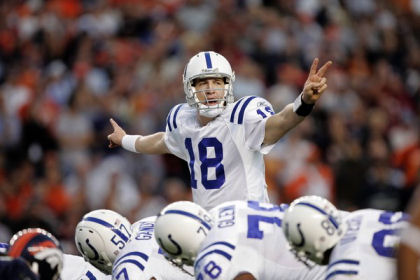 Back to the real stuff. The Peyton Manning who became known as The Sheriff. The field general
who controlled every aspect of the offense. The competitor who refused to miss a snap, regardless of what the game situation called for. The overseer at the line of scrimmage who barked out observations, orders and audibles, utilizing every possible second of the play clock before allowing the play to commence. Not a single moment of an Indianapolis Colt or Denver Bronco offensive play was missing Manning's fingerprint. He was the single most-prepared individual on the field at any given moment. His work ethic was unparalleled, spending hour after hour during offseasons getting in reps with his receivers, leaving no room for error in the timing of their routes and when and where the football would be delivered. His connections with Marvin Harrison, Reggie Wayne and Dallas Clark are legendary, and are what every teammate relationship should strive for.
He may not have been the most athletic quarterback in history. He will not have won the most Super Bowls, and most likely will not be regarded as the best quarterback the game has ever seen. But if there were ever an athlete I would want to model my competitive career after and influence others to do the same, it is Peyton Manning. The game may not lose him altogether, as he will likely be involved in coaching, broadcasting, analysis, or team management/ownership in some way or another. But his presence and value on the field will never be forgotten. Least of all by me. Goodbye, Peyton. Thank you.
Monday, March 7, 2016
Goodbye Peyton, Pt. 1: Retirement Press Conference
Peyton Manning announced his retirement from the NFL in a press conference held in Denver today. Here is the full video of his prepared statement, and the subsequent question and answer segment:
http://www.nfl.com/videos/denver-broncos/0ap3000000641998/Peyton-Manning-announces-his-retirement
Here are a few moments of personal significance for me:
(0:00-0:45) Mentions Marshall Faulk, Marvin Harrison, and Dan Marino as Hall-of-Famers on the field with him for his first game, and the moment he knew he would be able to compete in the league. #goosebumpsmoment number one.
(1:05- ) Johnny Unitas tells Peyton, "You stay at it. I'm pulling for you." He is surely proud of you, Peyton. As we all are. #goosebumpsmoment number two.
(1:35) "18 is a good number."
(2:00) Stay in school, kids! If it's good enough for Peyton to stay in college for four years, it should be good enough for you.
(3:10) Peyton still holds the record for interceptions by a rookie (28). 2nd-most is John Hadl with 24. Eli only had 9, but only started in 7 games.
(3:25) Weekly conversations with his grandfather about whether or not John Madden and Pat Summerall would cover Peyton's games. Not until his second year, when the Colts played the Cowboys: "I called Pa Pa. 'Guess what. Madden and Summerall are broadcasting the game.' He said, 'I can't believe it.' He was elated, he was very proud, and we beat the Cowboys that week, and we let the world know that the Colts had arrived." #goosebumpsmoment number three.
http://www.nfl.com/videos/denver-broncos/0ap3000000641998/Peyton-Manning-announces-his-retirement
Here are a few moments of personal significance for me:
(0:00-0:45) Mentions Marshall Faulk, Marvin Harrison, and Dan Marino as Hall-of-Famers on the field with him for his first game, and the moment he knew he would be able to compete in the league. #goosebumpsmoment number one.
(1:05- ) Johnny Unitas tells Peyton, "You stay at it. I'm pulling for you." He is surely proud of you, Peyton. As we all are. #goosebumpsmoment number two.
(1:35) "18 is a good number."
(2:00) Stay in school, kids! If it's good enough for Peyton to stay in college for four years, it should be good enough for you.
(3:10) Peyton still holds the record for interceptions by a rookie (28). 2nd-most is John Hadl with 24. Eli only had 9, but only started in 7 games.
(3:25) Weekly conversations with his grandfather about whether or not John Madden and Pat Summerall would cover Peyton's games. Not until his second year, when the Colts played the Cowboys: "I called Pa Pa. 'Guess what. Madden and Summerall are broadcasting the game.' He said, 'I can't believe it.' He was elated, he was very proud, and we beat the Cowboys that week, and we let the world know that the Colts had arrived." #goosebumpsmoment number three.
(4:35) "Treat a man as he is and he will remain as he is. Treat a manas he could be and he will become what he should be."
(6:45) Peyton’s conversation with his daughter, Mosley, is
why I can’t wait to have kids.
(7:15) “Mort and Adam Schefter had gotten to my daughter to
cultivate a new source.” Classic.
(7:45-9:40) “Teach them to enjoy the little things in life,
because one day they’ll look back and discover that those really were the big
things.” Followed by an incredible list of people, places, and moments.
#goosebumpsmomentnumber4
(9:09) “…And
afterwards I’ll miss recapping the game with my dad; and checking to see if the
Giants won, and calling Eli as we’re both on our team buses.” Almost cried.
#goosebumpsmomentnumber5
(10:12) “Football has taught me not to be lead by set back
and destructions, but to be lead by dreams.”
(10:30) “Life is not shrinking for me. It’s morphing into a
whole new world of possibilities.”
(10:50) "Every moment... was about one thing. Reverence for this game... There were other players who were more talented, but there was no one who could out-prepare me. And because of that I have no regrets."
(11:20) 2 Timothy 4:7 "God bless you all, and God bless football."
*Press conference starts at 12:40*
(17:05) I have a lot of bad words that I will spare you all to describe the woman who decided this moment was the right time to bring up the allegations about Peyton during his time at Tennessee. I understand it's a media event, and that you have a job, and the story is relevant in that it's been talked about over the last couple months. I get all of that. But all these couple of days leading up to this moment have been about have been celebrating this man. And you bring this up. I'm appalled, aggravated, and furious that you chose this moment to put yourself and your own agenda first.
BUT, Peyton is the most professional professional ever, addressed it calmly, and then quoted Forest Gump: "And that's all I have to say about that." Brilliant.
And he completes the whole conference in the best way possible: "Omaha."
Seriously. Watch at least his whole prepared speech at the start. It's worth it.
Thursday, September 18, 2014
Ray Rice, An Abbreviated Take
1. The release and indefinite suspension are absurd. Not because he didn't deserve it, but because he'd already been punished, and nothing changed. We knew (or at least had a pretty darn good idea) what happened in the elevator. Goodell and other NFL officials did know what happened because he told them. So to think that the video coming out was new information and warranted further persecution is insane, bordering on double jeopardy.
2. If they were both drunk, and I'm assuming they were, then I don't really think anything less of him. They have both been very honest and upfront about the whole thing, compliant from the very first moment information came out, and saying and doing all of the right things. People do stupid things when they're drunk. If they break the law, they deserve to be punished for it. Rice WASN'T EVEN CHARGED. If the law and Janay herself are allowing themselves to work it out, then I'm okay with siding that way, too.
3. We should not be surprised when professional athletes, especially football players, act in violent ways in their daily lives. We expect them to push their bodies to breaking points, be supremely aggressive and exhibit animalistic instincts on the field, THEIR ENTIRE LIVES, and then suddenly have the ability to turn that off when they're not playing? Yes, a lot of people can handle it, but I'm not shocked when that side comes out because it's what their body and mind have been trained to do since they were young. And it's our fault.
BY NO MEANS AM I CONDONING OR EXCUSING RAY RICE'S BEHAVIOR IN THE ELEVATOR.
What he did was atrocious. But since this ordeal began, Rice has said and done everything we can reasonably ask of him. He has shown great remorse, wants to move forward in a positive direction as well as he can, and has expressed an understanding of the much bigger picture that involves a future in which his daughter will ask questions. Janay has forgiven him (in public, anyway), and seems more than willing to be moving towards a brighter future with him. She is the victim, has seen a lot of support, and has made her own decisions about her future. The best we can do is show them love and attempt to guide them forward.
2. If they were both drunk, and I'm assuming they were, then I don't really think anything less of him. They have both been very honest and upfront about the whole thing, compliant from the very first moment information came out, and saying and doing all of the right things. People do stupid things when they're drunk. If they break the law, they deserve to be punished for it. Rice WASN'T EVEN CHARGED. If the law and Janay herself are allowing themselves to work it out, then I'm okay with siding that way, too.
3. We should not be surprised when professional athletes, especially football players, act in violent ways in their daily lives. We expect them to push their bodies to breaking points, be supremely aggressive and exhibit animalistic instincts on the field, THEIR ENTIRE LIVES, and then suddenly have the ability to turn that off when they're not playing? Yes, a lot of people can handle it, but I'm not shocked when that side comes out because it's what their body and mind have been trained to do since they were young. And it's our fault.
BY NO MEANS AM I CONDONING OR EXCUSING RAY RICE'S BEHAVIOR IN THE ELEVATOR.
What he did was atrocious. But since this ordeal began, Rice has said and done everything we can reasonably ask of him. He has shown great remorse, wants to move forward in a positive direction as well as he can, and has expressed an understanding of the much bigger picture that involves a future in which his daughter will ask questions. Janay has forgiven him (in public, anyway), and seems more than willing to be moving towards a brighter future with him. She is the victim, has seen a lot of support, and has made her own decisions about her future. The best we can do is show them love and attempt to guide them forward.
Thursday, August 21, 2014
10 Reasons This Guy Doesn't Know What He's Talking About
You can either read the article all the way through and then read mine, or go back and forth between the two. But here's the article: 10 Reasons The Little League World Series Needs To Go Away
Somebody somewhere decided this was a good measurement for these kids. The writer says, "When I was playing little league only about 2 kids in the league could hit an actual home run." For the most part, there are usually only a couple kids on each team, coincidentally representing just one league, who routinely hit home runs. Yes, some teams have more, but some teams have less. The game has not deteriorated to the point where it's determined by home runs quite yet, so I think we're doing ok. Additionally, "Also the outfielders play like 5th, 6th & 7th infielders because of it." Wait, so, hitters hit the ball too far, so the outfielders are going to play further up? I haven't seen that strategy implemented, um, ever...
5. Inclusion in Top Plays
This is just pure pessimism in my opinion. This is the ONE shot most of these kids ever have to have a cool thing they do be on television. And can we not forget that THEY ARE JUST KIDS! Yes, those plays are easy and routine for professionals. And yes, they just might be easy and routine for kids, too. But these are the only two weeks during the entire year where these amateur athletes have the opportunity to be applauded. There's only so many times I can tolerate watching Yasiel Puig highlights and the absurd propensity of walk-off hits everyday before I get bored.
4. The Umpires
Umpires know what a strike zone is. And they know that if they called exactly what they were supposed to there would be walk after walk after walk. And NOBODY wants that. I can guarantee it would be mind-numbing to watch on television, or in person as a parent, or in the dugout as a coach, or in the field as a player. Umpires must have a forgiving strike zone in order for the game to keep moving. That's the way it is, and has been for a long time.
Umpires don't generally have outlandish strike calls. Some of them are over the top, some of them are indecipherable, but most are right in the middle. Calling out all umpires for this is like calling out all football players as domestically violent. Some are, most aren't.
As for dramatic calls of safe and out in the field, let's get something straight here: EVERY UMPIRE IS A VOLUNTEER. NONE OF THEM ARE PAID. They are normal people, with families and everyday jobs, who have this as a hobby in which they are generally attempting to help and provide a much-needed service. Some of them happen to be good enough to help and provide at the highest level. Most of them DO NOT feel the pressure of thousands of attending eyes (and hundreds of thousands on television/internet) on a regular basis. So if it takes them an additional 0.75 seconds to make sure they're getting a call right (even if they mistakenly get it wrong) I'm gonna let that slide. Because I know what it's like to referee in front of 30 people, and that was the most nervous (and least appealing) situation I've ever experienced in my athletic life. Is it easy for us to make quick judgment calls watching on TV? Yes, because we won't instantly be blasted with anger and outrage upon making said judgment calls. But let me know the next time you go do some volunteer work, and I'll be happy to come down and criticize every little thing you do wrong. See how easy the rest of your day is from there.
3. The Bats
I also have no counter argument here, other than I hope this guy also hates watching golf, hockey, tennis, swimming, and every other professional sport that is greatly enhanced by the improving technology of equipment.
2. Not Even the Best Age for Little League
That seems rather objective. But he recycles arguments he made earlier, so I'll move on without doing the same.
1. These Aren't Going To Be Major League Players EVER
I mean, do I even have to argue this point? You're telling us you're less inclined to watch because they will never reach the absolute pinnacle of what they are doing? That's preposterous. And it sounds like he's pushing for support of AAU-type teams. He must not realize how money-driven that gets, and how nobody cares about academics, and it's only about exposure and catering to the players, and players transfer teams and schools frequently if they're not in a situation they think suits them. Which feeds into the over-fed, under-developed psyches that create immature, poor-decision-making professionals. But sure, go with that. Seems to be working out for basketball.
Bonus 1: Uniforms
From what I understand, teams are supplied with a uniform as they advance through the ranks. The All-Star team from individual leagues gets a uniform that they sport through their district tournaments. I'm not sure if that same uniform is kept into the State tournaments. When teams get to Regional tournaments, they get uniforms representing which state they are champions of. When they get to the World Series, they get to represent which region they are champions of. That seems like a pretty logical progression. And if you really want to know which league, city and state they are from, you merely have to pay attention to the broadcast for a couple of minutes. Every player who steps up to the plate has his state abbreviation shown to the side of his info box. Announcers name leagues and cities constantly, because THEY KNOW YOU WANT TO KNOW that information. Lastly, I'm pretty sure kids love receiving new, cool stuff just as much as showing off old, dirty stuff.
Bonus 2: Radar guns
He misses the point. Especially considering his cat joke. Adam Dunn recently pitched in a game for the White Sox. He's been a pro for a long time, played in the outfield for a while, and was a top high school quarterback recruit (would have started at Texas) when he was younger. In his pitching performance, his fastball "topped out at 83 mph." Sir, if Adam Dunn is barely getting over 80, I highly doubt you yourself would reach 75. So if 12 year old kids are reaching 70, I'm impressed. Also, when showing the "MLB 99" speed, ESPN is not suggesting that this kid will one day reach that velocity, or any other foreshadowing. They are equating reaction times. A ball moving at 70 mph from 46 feet away takes the same amount of time as a ball moving at 92 mph from 60 feet away. Therefore, a little league hitter has the same amount of time to react to a pitch as a major league hitter, in this situation. It's simple math, nothing more than that.
"And when I say it needs to go away, they can still play it. It's great for the kids. I would have loved to have that experience."
Woah, woah, woah! After all the bickering and complaining, you're actually okay with all of it? And completely support it? What was the point of the article, then?
Did I miss anything? Let me know.
10. It's Not Really Even Baseball
BECAUSE THEY'RE KIDS. Leading off creates a HUGE advantage at this age. There are a ton of stolen bases or runners advancing already. If they could steal, singles and walks would become triples almost every time. The fence distance will be addressed later. Everyone "has" to play? He's mad because everyone gets the opportunity to be in the field for ONE at bat (out of what is ususally three) and ONE inning in the field (out of 6)? I'm sorry, you don't get to be mad about that. Parents/families travel thousands of miles for weeks on end supporting these kids. Sometimes they lose their jobs as a result. If you were following your kid around the continent and didn't get to see him get on the field, you'd be PISSED. And it's not like the backups are scrubs. Every one of these kids was an All-Star from their local league. Yes, there's a drop off from the 1 or 2 best players, maybe even 3 or 4, but 5 through 13 are usually pretty interchangeable.
9. Stop With the Breaking Balls
This one I can't argue with too much, though I'm not sure where his 65% statistic comes from. I agree, there should be way more fastballs (60-70% at least) and changeups (15-20%) with only occasional (if not altogether dismissed) curveballs for the sake of young, developing arms. But throwing off speed pitches is almost as damaging as the year-round play that most kids do, instead of taking time off to do other sports and help arms develop in more well-rounded ways like they used to before the specialization we see now; in addition to the amount of traveling, year-round teams. As for learning to throw a fastball over the plate: THEY'RE 12! It's hard. And none of them are full-time pitchers. If you're not practicing that over and over again like, say, professional players, then it isn't that easy. There's a reason there are no position players that are also considered pitchers in the pros, whereas EVERY little league pitcher also plays at least one other position, if not 2 or 3.
8. Horrible Catching
He didn't even address that the actual level of skill at the position is lacking, he just said the job is much harder because of all the pitching inaccuracy. Thanks for not making your heading confusing...
7. The Wall is the Same Distance All the Way Around
When I mentioned this to my roommate, he was confused as to why it WOULDN'T be the same all the way around. Every other sport has dimensions that are uniform. Admittedly, this is a uniquely baseball characteristic: for field dimensions to be abstract by design. I do not have an actual counter-argument to this one. I just don't think it's that big of a deal.
6. It's Only 225 Feet to the Wall
Somebody somewhere decided this was a good measurement for these kids. The writer says, "When I was playing little league only about 2 kids in the league could hit an actual home run." For the most part, there are usually only a couple kids on each team, coincidentally representing just one league, who routinely hit home runs. Yes, some teams have more, but some teams have less. The game has not deteriorated to the point where it's determined by home runs quite yet, so I think we're doing ok. Additionally, "Also the outfielders play like 5th, 6th & 7th infielders because of it." Wait, so, hitters hit the ball too far, so the outfielders are going to play further up? I haven't seen that strategy implemented, um, ever...
5. Inclusion in Top Plays
This is just pure pessimism in my opinion. This is the ONE shot most of these kids ever have to have a cool thing they do be on television. And can we not forget that THEY ARE JUST KIDS! Yes, those plays are easy and routine for professionals. And yes, they just might be easy and routine for kids, too. But these are the only two weeks during the entire year where these amateur athletes have the opportunity to be applauded. There's only so many times I can tolerate watching Yasiel Puig highlights and the absurd propensity of walk-off hits everyday before I get bored.
4. The Umpires
Umpires know what a strike zone is. And they know that if they called exactly what they were supposed to there would be walk after walk after walk. And NOBODY wants that. I can guarantee it would be mind-numbing to watch on television, or in person as a parent, or in the dugout as a coach, or in the field as a player. Umpires must have a forgiving strike zone in order for the game to keep moving. That's the way it is, and has been for a long time.
Umpires don't generally have outlandish strike calls. Some of them are over the top, some of them are indecipherable, but most are right in the middle. Calling out all umpires for this is like calling out all football players as domestically violent. Some are, most aren't.
As for dramatic calls of safe and out in the field, let's get something straight here: EVERY UMPIRE IS A VOLUNTEER. NONE OF THEM ARE PAID. They are normal people, with families and everyday jobs, who have this as a hobby in which they are generally attempting to help and provide a much-needed service. Some of them happen to be good enough to help and provide at the highest level. Most of them DO NOT feel the pressure of thousands of attending eyes (and hundreds of thousands on television/internet) on a regular basis. So if it takes them an additional 0.75 seconds to make sure they're getting a call right (even if they mistakenly get it wrong) I'm gonna let that slide. Because I know what it's like to referee in front of 30 people, and that was the most nervous (and least appealing) situation I've ever experienced in my athletic life. Is it easy for us to make quick judgment calls watching on TV? Yes, because we won't instantly be blasted with anger and outrage upon making said judgment calls. But let me know the next time you go do some volunteer work, and I'll be happy to come down and criticize every little thing you do wrong. See how easy the rest of your day is from there.
3. The Bats
I also have no counter argument here, other than I hope this guy also hates watching golf, hockey, tennis, swimming, and every other professional sport that is greatly enhanced by the improving technology of equipment.
2. Not Even the Best Age for Little League
That seems rather objective. But he recycles arguments he made earlier, so I'll move on without doing the same.
1. These Aren't Going To Be Major League Players EVER
I mean, do I even have to argue this point? You're telling us you're less inclined to watch because they will never reach the absolute pinnacle of what they are doing? That's preposterous. And it sounds like he's pushing for support of AAU-type teams. He must not realize how money-driven that gets, and how nobody cares about academics, and it's only about exposure and catering to the players, and players transfer teams and schools frequently if they're not in a situation they think suits them. Which feeds into the over-fed, under-developed psyches that create immature, poor-decision-making professionals. But sure, go with that. Seems to be working out for basketball.
Bonus 1: Uniforms
From what I understand, teams are supplied with a uniform as they advance through the ranks. The All-Star team from individual leagues gets a uniform that they sport through their district tournaments. I'm not sure if that same uniform is kept into the State tournaments. When teams get to Regional tournaments, they get uniforms representing which state they are champions of. When they get to the World Series, they get to represent which region they are champions of. That seems like a pretty logical progression. And if you really want to know which league, city and state they are from, you merely have to pay attention to the broadcast for a couple of minutes. Every player who steps up to the plate has his state abbreviation shown to the side of his info box. Announcers name leagues and cities constantly, because THEY KNOW YOU WANT TO KNOW that information. Lastly, I'm pretty sure kids love receiving new, cool stuff just as much as showing off old, dirty stuff.
Bonus 2: Radar guns
He misses the point. Especially considering his cat joke. Adam Dunn recently pitched in a game for the White Sox. He's been a pro for a long time, played in the outfield for a while, and was a top high school quarterback recruit (would have started at Texas) when he was younger. In his pitching performance, his fastball "topped out at 83 mph." Sir, if Adam Dunn is barely getting over 80, I highly doubt you yourself would reach 75. So if 12 year old kids are reaching 70, I'm impressed. Also, when showing the "MLB 99" speed, ESPN is not suggesting that this kid will one day reach that velocity, or any other foreshadowing. They are equating reaction times. A ball moving at 70 mph from 46 feet away takes the same amount of time as a ball moving at 92 mph from 60 feet away. Therefore, a little league hitter has the same amount of time to react to a pitch as a major league hitter, in this situation. It's simple math, nothing more than that.
"And when I say it needs to go away, they can still play it. It's great for the kids. I would have loved to have that experience."
Woah, woah, woah! After all the bickering and complaining, you're actually okay with all of it? And completely support it? What was the point of the article, then?
Did I miss anything? Let me know.
Monday, March 3, 2014
The Answer is The Answer

With the Philadelphia 76ers retiring Allen Iverson's number 3 jersey into their rafters the other night, it got me to pondering:
In my basketball-watching lifetime, who has been the most influential player of my generation?
Hint: If your immediate response wasn't Allen Iverson, your skills of observation and deduction need polishing.
Mind you, "pondering" is not in my nature. And I am very stubborn about two basketball items: First, that Michael Jordan is the best, most important basketball player ever. I'm not going to defend that now, nor do I feel the need to defend it, but I know exactly what the opposition will say and I will not disagree with any of it. But it will not change my mind. Second, Kobe Bryant has been the best basketball player in the world since Jordan. LeBron James is the best right now, and has been for the last year or two, but that's it. Again, I know what the other side will say, but those points I WILL disagree with. Just not now.
Moving on. Kind of.
 |
If your definition of moving on is talking about the very thing
you just said you weren't going to talk about.
|
Iverson influenced the game in a similar way to Jordan in that he changed the way the game looked. Before Jordan, the league was dominated with short shorts and fundamentals like running, passing and shooting. Take my word for it, that's not quite what the game is about anymore. Julius Erving may have been the breakthrough for playing above the rim, but Jordan took it to another level. Dunking, or at least flying through the air and attacking the rim, went from being an occasional occurrence to a way of life. Posterizing wasn't a thing until Jordan started doing it to everyone. The way the game was played underwent a drastic, fundamental change that resonates harder today than it ever had previously. He also took the game global. There's a reason the 1992 Dream Team was so successful, and (no offense) it wasn't because of Charles Barkley and David Robinson, or even Larry Bird and Magic Johnson. It was because the entire world knew who Michael Jordan was. Gatorade and Nike (and Hanes, for that matter) would not have the market share they do without Jordan's involvement. He single-handedly, no exaggeration, turned both companies into the hands-down leading brands in their respective fields. Because of how he played the game. And players started wearing baggier shorts. Thank God for Michael Jordan.
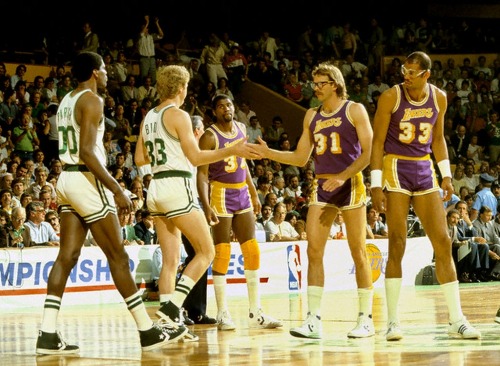 |
| If I just alienated the demographic of people reading this who supported this look, I am not sorry. Not even a little. |
Did Iverson, then, take the game to another level? Do other solar systems rep his jersey and buy his shoes? No. But how often do guys in pickup games across the country get clowned for getting their ankles broken by a nasty crossover? More importantly, how many small-ish dudes attack the basket with full force and little fear? The answers are very often, and more and more every day, respectively. The reason for those answers is The Answer.
 |
Did you know there was a band called The Answer? Me neither. Now this is confusing.
|
Of the 50 players with the most free throw attempts per game all-time, only 5 of them are under 6'4". Jerry West and World B. Free were 6'2", Lenny Wilkens and Nate "Tiny" Archibald were 6'1", and Iverson was 6'0". There's a reason the other 45 players on the list are bigger, and that's because getting to the free throw line requires getting fouled, and getting fouled usually involves being close to the basket, and being close to the basket usually involves running into very large people, and running into very large people is something usually only other very large people can sustain for a long enough time to rack up all those free throw attempts. To this point in the 2013-2014 season, you only have to go through the top 20 to find 7 players under 6'4", and 2 of them are under 6 feet. Last year 5 of the top 20 fit the under-6'4" demographic. If you go back to early in Iverson's career (as far back for these stats as I could find), in the 1999/2000 season, the only such players in the top 40 were Iverson, Stephon "Starbury" Marbury and Sam Cassell. Iverson's determination to get to the hoop, take a pounding, pop right up and do the same process again the next time down the court became an inspiration to smaller basketball players all over the country. Plus, how cool does it look when short guys dunk? Especially in crowds and over big guys:
Note: The accompanying music is explicit, so mute the sound if that will bother you.
Do you think Nate Robinson would have been able to do any of this without the influence of watching Allen Iverson fly towards the rim over and over again? I don't think so. And that wasn't even Iverson's biggest contribution to the game.
The And1 Mixtape Tour (now referred to as the And1 Live Tour) began the streetball trend when it released its first mixtape in 1999. Featuring Skip 2 My Lou aka Rafer Alston, a future NBA player with a short-lived career, the mixtape became very popular and led to a quickly growing tour and fan base. Iconic players such as Hot Sauce and The Professor took off in name and image recognition, not because of their high-flying abilities, but because of their slick, chaotic ball-handling skills. All of the sudden, it became just as cool to embarrass somebody by breaking their ankles or dribbling circles around them as it was to dunk over them. It's no coincidence that Iverson's career started in 1996 and that his first All-Star game appearance was during the 1999-2000 season, the same year the first And1 mixtape came out. All it takes is watching these last 15 moves (skip to the 11:30 mark) to see where those guys probably got their inspiration from:
Then take a couple minutes to peruse this video of some of the other best crossovers over some recent span of time in the NBA:
How many of those look like they were before 2000? Very few. How many of them look like they were probably influenced by moves Iverson himself pulled off in the previous video? Almost all of them.
Did I want to grow up to be like Allen Iverson? No. To this day I've never really understood cornrows or guys wearing earrings. That's not a criticism; I don't understand running cross country or eating vanilla ice cream, either. But I digress. I'm 6'7", 225 lbs, slow, with no leaping ability. I'm Mike Dunleavy Jr. You laugh, but you wish you were an 11-year NBA veteran with a career averages of 12 points and 28 minutes per game. Where was I. Oh yeah. No, I didn't want to be Iverson, but I sure didn't mind watching him on a regular basis. It was like watching David versus Goliath, except every day there was a new Goliath, and every day David found a new way to beat him and embarrass him, all the while changing how people went about slaying giants. That's a thing, right?
Looking back on all of the sports I watched when I was younger, I realized that I missed the opportunity to really take in some phenomenal players. Allen Iverson is near the top of that list. Putting some of his numerous off-court troubles aside, Iverson was one of the most dynamic, compelling characters the NBA ever put on the court, and he left a lasting impact on the game that will not fade soon. His presence will be missed.
An article about Iverson would be incomplete without referencing his "practice" habits, so here you go:
Friday, February 21, 2014
6 of the Most WTF Moments in Sports (That Counted)
Sports are awesome for a lot of reasons. With the recent completion of the Winter Olympics in Sochi, we are reminded how people from all over the world, from different cultures, belief systems and training habits, can come together in the spirit of competition and coexist peacefully. We also get to watch the most incredible moments of drama play out on fields, courts, rinks and pitches across the world; athletes overcoming personal tragedy and physical limitations to excel at the highest levels. And there are no two better words in the English language than "Game Seven" for excitement and intensity.
Sports also allow us to see the most physically gifted people in the world perform the most amazing feats of athleticism that us common folk can only dream about. Sometimes they leave us in awe, dumbfounded by what we just witnessed. But some plays are so far out of the realm of normalcy that we are left pondering, "What the ----?"
June 6, 1999
"Love The Glove"
Orlando Hernandez
The Yankees are hosting the Mets in an afternoon game at Yankee Stadium. The Mets are already up 1-0 in the top of the 2nd, having just scored a run that inning and threatening for more. Mets third baseman Robin Ventura is the runner on third as shortstop Rey Ordonez comes to the plate. On an 0-1 count, Ordonez hits a sharp one-bouncer back to the mound, where Orlando "El Duque" Hernandez is the Yankees' starting pitcher for the day. (El Duque, roughly translated, means "The Duke." I doubt Hernandez actually has governing power over any body of constituents, but you never know.) Hernandez quickly stabs at the ball. Then something I've never seen before or since happens.
The best part about this play is, as you can see at the end of the video, Hernandez is completely focused on the play from start to finish. When he first fields the ball, he takes a split second to check Ventura back to 3rd base. As he makes his move towards first, he becomes aware of his odd situation and without a moment's hesitation references in his mind the words of Sherlock Holmes: "When you have eliminated the impossible, whatever remains, however improbable, must be the truth." Ok, that's not exactly relevant, but the idea is something crazy just happened so the only logical thing to do is go along with it. He then proceeds to launch the ball as is, lodged tight in the webbing of his glove, over to Yankees' first baseman Tino Martinez to record the out. Martinez is similarly professional about the situation, which makes this slightly less entertaining. (Or more so if you're announcers Joe Buck and Tim McCarver, because they are clearly VERY entertained.) Hernandez being able to consider all of this in his mind in mere microseconds, (that's a thousandth of a thousandth of a second for you non-sabermetricians) is impressive. Actually getting the blob that was the ball and glove over to first base is even more impressive. Making weight calibrations on the fly isn't the easiest thing in the world; that's why the players warm up before every inning. But the first thing Hernandez does after ridding himself of the mitt-ball monstrosity is look back at Ventura to make sure he hasn't tried to take advantage of the strange situation and advance home for a run. Awareness win. Strangeness double win.
January 4, 2007
"Open Net Bungle"
Patrick Stefan
There are 12 seconds left against the Edmonton Oilers when Dallas Stars centerman Patrik Stefan controls the puck after an Oiler turns it over at the Edmonton blue line. The Stars currently have a 5-4 lead, and Edmonton has already pulled their goalie for an extra attacker in hopes of tying the score. This means there is literally nobody between Stefan and scoring a goal for an insurmountable 2 goal lead and effectively ending the game. Things didn't turn out as he'd expected:
There are bad bounces, there are really bad bounces, and then there's just bad luck. Stefan experienced a bit of the latter, because of multiple things. First, the ice at the end of the period becomes pretty rough. With all the skating and stoping and sliding and chipping, the ice gets beat up, especially in the crease where the goalie normally is. That's why Zambonis have to work on the ice at the end of each period, to smooth the ice for premium playing conditions. Stefan had the unfortunate circumstance of the puck lying perfectly flat on the ice one second, then doing it's best jumping bean impression right over his stick the next second. Now, this normally would not have been a big deal. Mishandled puck, there's only a few seconds left, just suck it up, collect yourself, and let time run out. Instead, Stefan has a mental freakout and reacts instinctively with the mindset of absolutely having to score a goal. In his desperation to right the ship and still get a shot on goal, he completely wipes out and goes sliding into the boards. The Oilers are on it and immediately start a fast break the other way. After some deft passing and a slick maneuver by Alex Hemsky past the goalie, in a process that takes about seven seconds, the Oilers tie the game and both teams go into overtime. Dallas ended up winning the game, but you can bet Patrik Stefan will be reliving that moment in his nightmares.
March 20, 2005
"The Greatest Basketball Shot Ever"
Blake Hoffarber
Some kids spend a good amount of time in their driveways or at their local parks pretending to count down the seconds at the end of a basketball game and throwing up a crazy shot that miraculously goes in for the fictional win. Most of us can only dream of one day being in a position that lives up to that wild fantasy. Others of us are Blake Hoffarber, competing in the 2005 Minnesota High School State Basketball Championship tournament, fulfilling this destiny to an unprecedented degree.
Hoffarber's Hopkins High team is down by 2 to Eastview High with time winding down in the first overtime period. Hopkins has the ball, trying to force another overtime or go for the win, when their possession goes awry and a mad scramble occurs. Enter Blake:
What you saw there was a moment that won the 2005 ESPY Award for Best Play, keeping some incredible company with the likes of Jadeveon Clowney, David Tyree, Derek Jeter, and another entry later in this article. Hoffarber fancied himself a liking to these types of situations, earning another Best Play nomination (to this point the only individual to receive two such nominations) a couple years later for this game-winning shot against Indiana University while playing for Minnesota in the quarterfinals of the Big Ten Tournament. Unlike his play against the Hoosiers, Blake's high school shot did not win the game in that singular moment. It did send the game into double overtime, however, where Hopkins High team eventually prevailed over Eastview High. Crazy plays and buzzer-beaters happen all the time, but it's not often they combine in this fashion AND win you a state championship.
December 22, 1994
"Play of the Decade"
Isaiah (J.R.) Rider, Jr.
As insanely good plays are want to do, this one started with a bad pass from Minnesota Timberwolves teammate Winston Garland. What appears to be a miscommunication between Rider and Garland results in the ball being passed behind Rider. In his desperation to recover, Rider knocks the ball away from himself towards the sideline. He launches off of his right foot, corrals the ball in his right hand, swings it across his midsection and flings the ball way into the air, all while soaring towards the scorers table. Multiple players from the opposing Sacramento Kings take off towards their own offensive basket, anticipating a quick fast break opportunity. Much to their chagrin, and the shock of all 17,000+ people in attendance, the ball sails directly through the net. Kings guard Mitch Richmond can't help but come over and high-five Rider in congratulations afterwards. It's not often you get to witness that kind of play in person. Well, if the announcer is to be believed, once in a decade.
September 10, 2005
"The Catch"
Tyrone Prothro
This bears less explanation and more revelry, but for my own selfish conceitedness (and redundancy?):
Alabama is down by 11 to Southern Mississippi with halftime quickly approaching. That's important because Crimson Tide quarterback Brodie Croyle isn't just roaming around throwing up hospital passes for no reason. This is Alabama's second game of the season, and they're losing to a Conference USA team. That's not how Alabama rolls. (See what I did there?) He's trying to make a play and avoid a humiliating loss.
The Southern Miss defender has nearly-perfect coverage, though you could argue he was face-guarding and deserving of a pass interference penalty. Prothro has to adjust back to the ball, but has almost nowhere to put his hands to have a legitimate shot at catching the ball. So, he puts his hands around the defender, and manages to close them on the ball at the exact moment that the ball hits the defender in the back. For those curious, this does qualify as having possession of the football. The amazing thing that follows is Prothro manages to maintain that possession through falling to the ground and FLIPPING OVER THE DEFENDER ONTO HIS HEAD. Enough said.*
*It's also important to note that those were the first 7 points in an unanswered 20-point run to eventually win the game 30-21 and create some major momentum for the rest of their season.
January 16, 2006
"When It Was No Longer Possible"
Alexander Ovechkin
As if it's even necessary, though it's clearly not, I'm going to point out a couple things from that play:
-He's sliding ON HIS BACK.
-He can't see the net, goalie, other defenders, or his teammates, because he's ON HIS BACK facing the boards.
-He finishes ON HIS BACK with one hand on his stick.
The icing on the cake, or cherry on the sundae, or whatever your favorite metaphor for pinnacle is, is that Wayne Gretzky, the greatest goal scorer in the history of hockey (and the single most dominant athlete ever) is sitting on the Phoenix Coyotes' bench as the opposing team's head coach to witness this play. Nothing could be more perfect. Well, maybe if Ovechkin's Washington Capitals weren't already winning 5-1 in the 3rd period, so adding a sixth goal didn't really do much for them, but who's counting?
Sports also allow us to see the most physically gifted people in the world perform the most amazing feats of athleticism that us common folk can only dream about. Sometimes they leave us in awe, dumbfounded by what we just witnessed. But some plays are so far out of the realm of normalcy that we are left pondering, "What the ----?"
June 6, 1999
"Love The Glove"
Orlando Hernandez
The Yankees are hosting the Mets in an afternoon game at Yankee Stadium. The Mets are already up 1-0 in the top of the 2nd, having just scored a run that inning and threatening for more. Mets third baseman Robin Ventura is the runner on third as shortstop Rey Ordonez comes to the plate. On an 0-1 count, Ordonez hits a sharp one-bouncer back to the mound, where Orlando "El Duque" Hernandez is the Yankees' starting pitcher for the day. (El Duque, roughly translated, means "The Duke." I doubt Hernandez actually has governing power over any body of constituents, but you never know.) Hernandez quickly stabs at the ball. Then something I've never seen before or since happens.
The best part about this play is, as you can see at the end of the video, Hernandez is completely focused on the play from start to finish. When he first fields the ball, he takes a split second to check Ventura back to 3rd base. As he makes his move towards first, he becomes aware of his odd situation and without a moment's hesitation references in his mind the words of Sherlock Holmes: "When you have eliminated the impossible, whatever remains, however improbable, must be the truth." Ok, that's not exactly relevant, but the idea is something crazy just happened so the only logical thing to do is go along with it. He then proceeds to launch the ball as is, lodged tight in the webbing of his glove, over to Yankees' first baseman Tino Martinez to record the out. Martinez is similarly professional about the situation, which makes this slightly less entertaining. (Or more so if you're announcers Joe Buck and Tim McCarver, because they are clearly VERY entertained.) Hernandez being able to consider all of this in his mind in mere microseconds, (that's a thousandth of a thousandth of a second for you non-sabermetricians) is impressive. Actually getting the blob that was the ball and glove over to first base is even more impressive. Making weight calibrations on the fly isn't the easiest thing in the world; that's why the players warm up before every inning. But the first thing Hernandez does after ridding himself of the mitt-ball monstrosity is look back at Ventura to make sure he hasn't tried to take advantage of the strange situation and advance home for a run. Awareness win. Strangeness double win.
January 4, 2007
"Open Net Bungle"
Patrick Stefan
There are 12 seconds left against the Edmonton Oilers when Dallas Stars centerman Patrik Stefan controls the puck after an Oiler turns it over at the Edmonton blue line. The Stars currently have a 5-4 lead, and Edmonton has already pulled their goalie for an extra attacker in hopes of tying the score. This means there is literally nobody between Stefan and scoring a goal for an insurmountable 2 goal lead and effectively ending the game. Things didn't turn out as he'd expected:
There are bad bounces, there are really bad bounces, and then there's just bad luck. Stefan experienced a bit of the latter, because of multiple things. First, the ice at the end of the period becomes pretty rough. With all the skating and stoping and sliding and chipping, the ice gets beat up, especially in the crease where the goalie normally is. That's why Zambonis have to work on the ice at the end of each period, to smooth the ice for premium playing conditions. Stefan had the unfortunate circumstance of the puck lying perfectly flat on the ice one second, then doing it's best jumping bean impression right over his stick the next second. Now, this normally would not have been a big deal. Mishandled puck, there's only a few seconds left, just suck it up, collect yourself, and let time run out. Instead, Stefan has a mental freakout and reacts instinctively with the mindset of absolutely having to score a goal. In his desperation to right the ship and still get a shot on goal, he completely wipes out and goes sliding into the boards. The Oilers are on it and immediately start a fast break the other way. After some deft passing and a slick maneuver by Alex Hemsky past the goalie, in a process that takes about seven seconds, the Oilers tie the game and both teams go into overtime. Dallas ended up winning the game, but you can bet Patrik Stefan will be reliving that moment in his nightmares.
March 20, 2005
"The Greatest Basketball Shot Ever"
Blake Hoffarber
Some kids spend a good amount of time in their driveways or at their local parks pretending to count down the seconds at the end of a basketball game and throwing up a crazy shot that miraculously goes in for the fictional win. Most of us can only dream of one day being in a position that lives up to that wild fantasy. Others of us are Blake Hoffarber, competing in the 2005 Minnesota High School State Basketball Championship tournament, fulfilling this destiny to an unprecedented degree.
Hoffarber's Hopkins High team is down by 2 to Eastview High with time winding down in the first overtime period. Hopkins has the ball, trying to force another overtime or go for the win, when their possession goes awry and a mad scramble occurs. Enter Blake:
What you saw there was a moment that won the 2005 ESPY Award for Best Play, keeping some incredible company with the likes of Jadeveon Clowney, David Tyree, Derek Jeter, and another entry later in this article. Hoffarber fancied himself a liking to these types of situations, earning another Best Play nomination (to this point the only individual to receive two such nominations) a couple years later for this game-winning shot against Indiana University while playing for Minnesota in the quarterfinals of the Big Ten Tournament. Unlike his play against the Hoosiers, Blake's high school shot did not win the game in that singular moment. It did send the game into double overtime, however, where Hopkins High team eventually prevailed over Eastview High. Crazy plays and buzzer-beaters happen all the time, but it's not often they combine in this fashion AND win you a state championship.
December 22, 1994
"Play of the Decade"
Isaiah (J.R.) Rider, Jr.
Isaiah Rider's career had it's series of ups and downs, peaks and pitfalls. The greatest of which might have been his 1994 Slam Dunk Contest championship. But even better than his between-the-legs, self-titled "East Bay Funk Dunk," the moment that he may be remembered for in history is this:
As insanely good plays are want to do, this one started with a bad pass from Minnesota Timberwolves teammate Winston Garland. What appears to be a miscommunication between Rider and Garland results in the ball being passed behind Rider. In his desperation to recover, Rider knocks the ball away from himself towards the sideline. He launches off of his right foot, corrals the ball in his right hand, swings it across his midsection and flings the ball way into the air, all while soaring towards the scorers table. Multiple players from the opposing Sacramento Kings take off towards their own offensive basket, anticipating a quick fast break opportunity. Much to their chagrin, and the shock of all 17,000+ people in attendance, the ball sails directly through the net. Kings guard Mitch Richmond can't help but come over and high-five Rider in congratulations afterwards. It's not often you get to witness that kind of play in person. Well, if the announcer is to be believed, once in a decade.
September 10, 2005
"The Catch"
Tyrone Prothro
Football players make ridiculous plays all over the place. Whether they're doing backflips, front flips, or stopping on a dime and using one hand, the athleticism and hand-eye coordination of wide receivers is remarkable. Then sometimes they do things that make no sense and have no explanation and you just have to accept that he scored a touchdown and move on. This is the best catch I've ever seen, and Tyrone Prothro couldn't even see it himself:
This bears less explanation and more revelry, but for my own selfish conceitedness (and redundancy?):
Alabama is down by 11 to Southern Mississippi with halftime quickly approaching. That's important because Crimson Tide quarterback Brodie Croyle isn't just roaming around throwing up hospital passes for no reason. This is Alabama's second game of the season, and they're losing to a Conference USA team. That's not how Alabama rolls. (See what I did there?) He's trying to make a play and avoid a humiliating loss.
The Southern Miss defender has nearly-perfect coverage, though you could argue he was face-guarding and deserving of a pass interference penalty. Prothro has to adjust back to the ball, but has almost nowhere to put his hands to have a legitimate shot at catching the ball. So, he puts his hands around the defender, and manages to close them on the ball at the exact moment that the ball hits the defender in the back. For those curious, this does qualify as having possession of the football. The amazing thing that follows is Prothro manages to maintain that possession through falling to the ground and FLIPPING OVER THE DEFENDER ONTO HIS HEAD. Enough said.*
*It's also important to note that those were the first 7 points in an unanswered 20-point run to eventually win the game 30-21 and create some major momentum for the rest of their season.
January 16, 2006
"When It Was No Longer Possible"
Alexander Ovechkin
What I could do is present you with a long list of impressive goals scored by talented hockey players. I could even just show a highlight reel consisting of nothing but Alexander Ovechkin, and that would be fairly satisfying. But this is the single greatest goal I have ever seen scored in my life, and there's no point trying to stack it up with anything else out there, because they all fall laughably short:
As if it's even necessary, though it's clearly not, I'm going to point out a couple things from that play:
-He's sliding ON HIS BACK.
-He can't see the net, goalie, other defenders, or his teammates, because he's ON HIS BACK facing the boards.
-He finishes ON HIS BACK with one hand on his stick.
The icing on the cake, or cherry on the sundae, or whatever your favorite metaphor for pinnacle is, is that Wayne Gretzky, the greatest goal scorer in the history of hockey (and the single most dominant athlete ever) is sitting on the Phoenix Coyotes' bench as the opposing team's head coach to witness this play. Nothing could be more perfect. Well, maybe if Ovechkin's Washington Capitals weren't already winning 5-1 in the 3rd period, so adding a sixth goal didn't really do much for them, but who's counting?
Subscribe to:
Posts (Atom)